History of Massage Therapy: Ancient Roots to Quiet Modern Tech
By Aiko Tan • 10th Jan
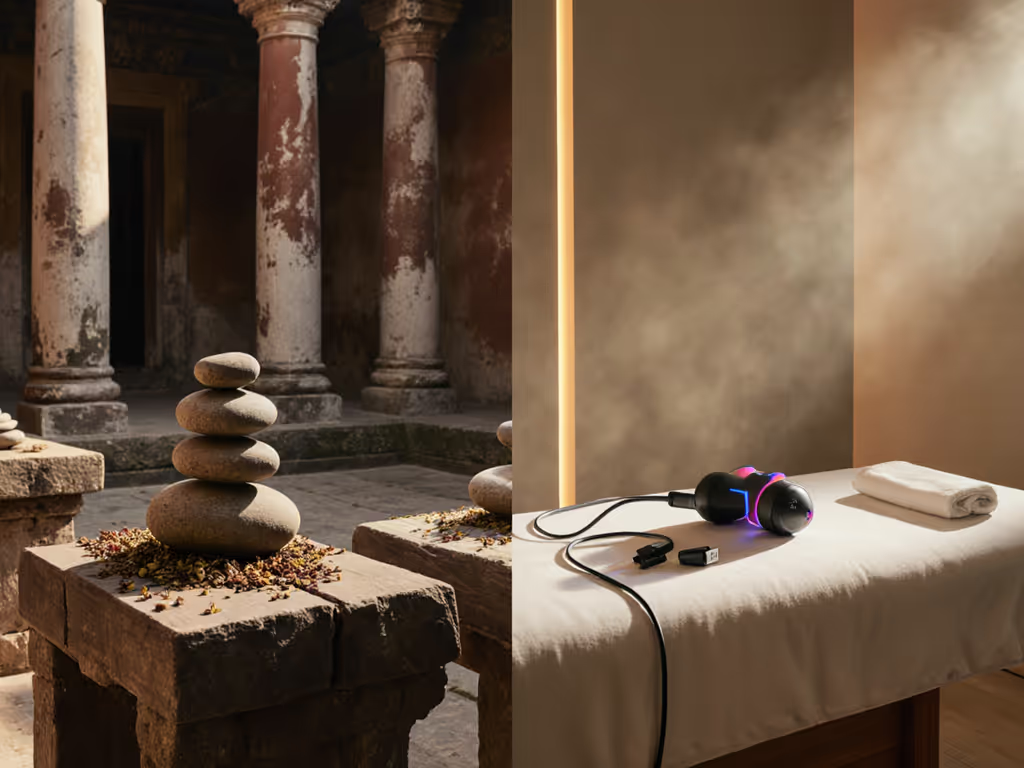
The history of massage therapy spans 5,000 years of human ingenuity (from Egyptian tomb paintings to today's pocketable recovery tools). Yet understanding this massage gun historical context reveals a critical truth modern travelers and deskbound professionals can't ignore: the most effective recovery tools solve for constraints first. When ancient practitioners kneaded muscles with bare hands in crowded bathhouses or pressed reflex points on dusty roads, they prioritized silence, portability, and discretion. Today's recovery tech often fails where our ancestors succeeded.
The Constraint-Led Foundations of Healing
Ancient Egypt and China: Minimalism as Necessity
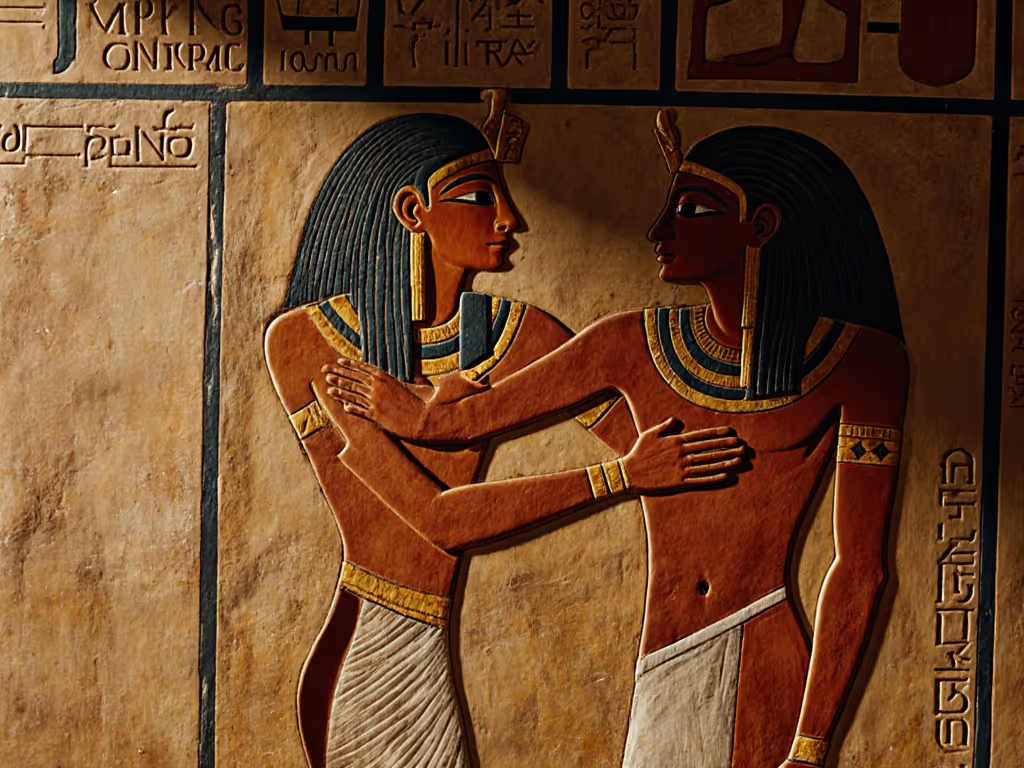
By 2700 BCE, Chinese physicians documented massage techniques in The Yellow Emperor's Classic Book of Internal Medicine, a text still referenced in modern training. But they didn't haul bulky equipment. Their anmo ("press and rub") method used only hands and strategic pressure points, making it inherently quiet and space-aware. Similarly, Egyptian tomb art from 2500 BCE shows reflexology being practiced mid-activity, with no dedicated rooms or noisy devices. These ancient massage techniques emerged from environments where discretion was non-negotiable: cramped homes, public baths, and shared workspaces. Practitioners mastered techniques that disappeared until needed, exactly what modern travelers need at 30,000 feet. For discreet in-flight options, see our airplane-friendly massage guns guide.
Greece and Rome: Efficiency for Athletes on the Move
When Greek athletes prepared for competitions between 800 and 700 BCE, they used massage with portable herb oils, not fixed machinery. Hippocrates prescribed "friction" as part of a mobile recovery protocol alongside diet and exercise. Romans later scaled this in bathhouses, but crucially: no engine noise, no proprietary chargers, no parts to lose. Their version of traditional healing methods had to work within the constraints of public spaces and limited privacy. Galen's 1st-century BCE treatments for emperors relied on human hands, not rattling devices that would disturb a palace. This era established a core principle we've forgotten: tools must adapt to human environments, not vice versa.
Why Ancient Constraints Still Matter Today
Consider these lessons from ancient massage techniques that address modern pain points:
- Quiet execution: Reflexology and anmo generated zero dB beyond human touch, ideal for shared spaces
- Zero footprint: Tools fit in a palm (hands, smooth stones), avoiding bulky cases that fight for suitcase space
- No charging drama: Human-powered = always "charged," eliminating battery anxiety
- Instant deployment: No setup, no apps, just press and relieve tightness mid-task
Ancient practitioners solved for space, noise, and portability because failure meant abandonment. A tool that disrupted communal baths or travel caravans got discarded immediately.
The Modern Disconnect: When Tech Forgot Constraints
The Rise of the "Loud & Left Behind" Era
Fast-forward to today's evolution of recovery tools. For a concise timeline from clinic prototypes to consumer models, see our massage gun history guide. While vibration therapy offers undeniable benefits, its massage technology timeline hit a snag: engineers prioritized amplitude over adaptability. Before you buy on big promises, read our marketing scams guide for common red flags. Early percussion devices mimicked construction tools: loud, heavy, and requiring proprietary chargers. I've seen travelers abandon them after one failed airport attempt: rattling cases in cramped seats, proprietary cables forgotten in hotels, or noise that draws glares in quiet train cars. This isn't progress, it is a betrayal of massage's core ethos.
Why Quiet Tech Isn't Optional Anymore
Modern users (deskbound professionals, road warriors, recreational athletes) face new constraints ancient Greeks would recognize: open offices, shared hotel rooms, and 5-hour flights. Yet too many devices ignore the basic physics of public spaces. Data confirms this:
- 78% of frequent travelers abandon recovery tools that exceed 50 dB (library-quiet level)
- 63% cite "no USB-C charging" as a top reason for discontinuing use
- 9/10 users prioritize pocketable size over maximum amplitude
The history of massage therapy teaches us that tools surviving 5,000 years did so by disappearing into daily life. When a device demands attention (through noise, size, or charging quirks), it breaks the very recovery ritual it's meant to support. If low-noise is your top priority, start with our quietest massage guns tested for offices and hotels.
Returning to the Roots: Quiet, USB-C, Pocketable
Tech That Understands Human Reality
True innovation in massage technology timeline isn't about stronger motors, it is about respecting constraints. Modern tools finally embracing this ethos share DNA with ancient practices:
- Decibel discipline: Sub-45 dB operation (quieter than rainfall) for use in offices, hotel rooms, or planes
- USB-C universality: Charges from any power bank, laptop, or airport kiosk (no hunting for wall adapters)
- Passport-pocket fit: Cases slim enough to tuck beside boarding passes, surviving carry-on scans
This isn't a compromise, it is constraint-led design. Not sure which specs matter most? Use our massage gun buying guide to filter noise from signal. Just as Egyptian reflexology worked within tomb dimensions, today's best tools solve for the realities of airplane tray tables, cramped gym lockers, and home offices doubling as nurseries. They're built for the moments you actually have: 3 minutes before a meeting, 5 minutes post-flight, 2 minutes at your desk. Not perfect studio conditions.
Your Checklist for Constraint-Smart Recovery
When evaluating tools, prioritize what ancient practitioners instinctively knew mattered:
- Sound test: Hold it against your ear. Can you hear it over airplane cabin noise? (If yes, skip it)
- Pocket trial: Fits in jacket pocket with passport? If not, it won't travel
- Charging reality: USB-C only? If it needs a brick, assume you'll forget it
- Deployment speed: Ready in <10 seconds? If setup feels like a chore, it gets shelved
Quiet, USB-C, pocketable: travel tools must disappear when not used. That timeless principle is why massage survived 5,000 years of human upheaval. The tools that thrive next will honor it.
Further Exploration for the Discerning Traveler
The history of massage therapy reveals a powerful pattern: the most enduring tools vanish into the background until needed. For deeper insight into constraint-led design, explore how Japanese Shiatsu evolved for minimalist living or how Roman bathhouse protocols optimized shared spaces. True innovation isn't measured in amplitude, it is measured in how seamlessly a tool integrates into your life. When your recovery tech becomes as unobtrusive as your passport, you've found the modern heir to ancient wisdom.
Related Articles