Motorcycle Massage Gun Comparison: Skip the Hype
By Priya Menon • 28th Apr
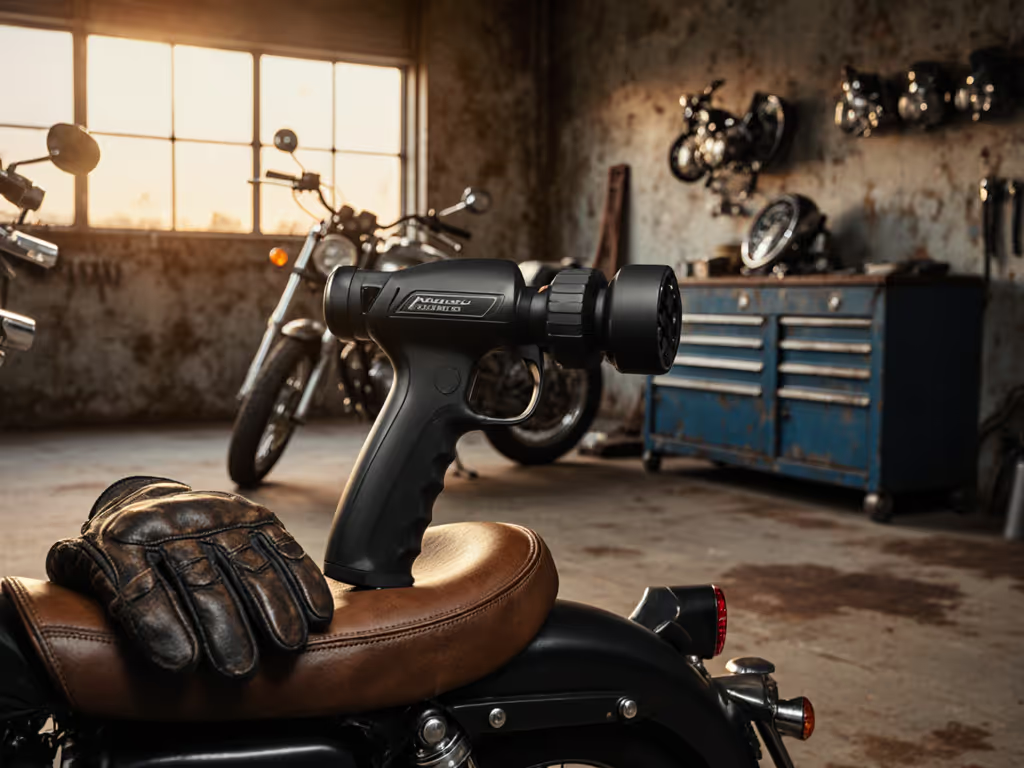
If you've spent hours hunched over a throttle or locked into an aggressive sport-bike posture, you already know that motorcycle massage guns aren't luxury; they are recovery infrastructure. But the market swarms with claims about amplitude, stall force, and "percussive therapy" that sound more like marketing than medicine. I've tested the same way, every time, so results translate, and when I say most motorcycle riders are buying the wrong tool, I mean they're measuring the wrong specs and ignoring the ones that actually matter for 500 miles of riding.
This isn't a roundup of "the best." This is a framework for cutting through noise (literal and metaphorical) to find what won't sit unused on a shelf.
What Do Motorcycle Riders Actually Need From a Massage Gun?
Motorcycle posture is a muscle trap. Your shoulders roll forward, your lower back flattens, your forearms and wrists absorb vibration, and your hips lock after hours of pressure on the seat. A massage gun designed for gym-goers doing foam-rolling at home won't always address those specifics. Numbers first, then hands-on sanity: before you pick a tool, you need to know:
- Noise level (decibels): Can you use it in a hotel room without waking your partner or triggering noise complaints?
- Amplitude (millimeters): Does the head travel far enough to reach deep tissue, or is it just buzzing the surface?
- Stall force (pounds): Does it maintain power when you press into tight muscle, or does it choke out?
- Weight and balance: Can you hold it steadily on your own back for 3-5 minutes, or does your arm tire before your muscle does?
- Battery life and charging: Will it last a road trip, and can you charge it without proprietary cables?
According to one standardized test of popular models, amplitude typically ranges from 6mm to 16mm, with most landing around 12mm.[1] Stall force varies widely, from 20 to 80 pounds, and speed ranges from 1000 to 2800 RPM, with most devices offering at least three selectable speeds.[1] But here's where riders go wrong: they chase the biggest amplitude or highest force, thinking "more" means better relief. It doesn't. It means harshness, fatigue, and abandonment. For a deeper look at misleading claims, read our massage gun marketing scams guide.
FAQ: Cutting Through the Clutter
Question: Is a Quiet Massage Gun Worth the Premium?
Answer: Yes, if you actually use it.
I learned this the hard way. We built a decibel rig in a closet to simulate late-night apartment use. A flashy, high-force flagship failed the quiet test immediately. It woke my toddler from three rooms away. An affordable alternative, oddly, passed with room to spare. Since then, I measure noise first. See the quietest massage guns we tested for offices and hotels to benchmark what "quiet" really means.
Since noise levels are rarely published, real-world comparison tests are sparse. But one roundup of popular models found significant variance: some models pulse between 50 to 70 decibels depending on speed setting.[2] For context, 50 dB is a quiet office; 70 dB is a busy coffee shop. If you travel, use the device before dawn, or share living space, a quieter model sits on the nightstand instead of in a closet. That matters more than an extra 2mm of amplitude.
Question: Amplitude, Stall Force, Speed: Which Matters Most?
Answer: All three interact. Pick based on your tightness and your grip strength.
Riders with chronically tight lower backs and glutes often assume higher amplitude automatically means deeper relief. In standardized testing, the relationship isn't linear. A 12mm amplitude at high stall force with consistent pressure beats a 16mm amplitude that breaks apart when you lean into tight tissue. Speed is the quiet variable: lower RPM (1000-1200) feels smoother and less prickly; higher RPM (2400-2800) delivers faster percussive input but can feel jarring if the head is too light or the amplitude is uncontrolled.
Practical translation for riders:
- Upper back and neck tightness: Choose 10-12mm amplitude, moderate force, speed you can control (adjustable is essential).
- Lower back and glutes: Aim for 12-14mm amplitude with stable stall force; don't chase 16mm unless you have the grip strength to keep pressure steady.
- Calves and IT band: Lighter models (under 2 pounds) with 8-10mm amplitude reduce fatigue during longer sessions; higher force here is wasted.
Question: Should I Buy the Quietest Model, Even If It's Less Powerful?
Answer: Test the tradeoff, then decide.
One comparative test noted that an acoustically efficient model delivered approximately 80% of the force of a louder flagship while weighing 0.75 pounds less and operating at a noticeably lower noise level.[2] The practical question: is that 20% force loss a dealbreaker for your use case? For most riders doing 5-10 minute recovery sessions on a road trip, the answer is no. For someone with severe DOMS after a racing event, maybe.
This is where transparent methods help. Request the decibel rating and stall force from the manufacturer or independent reviewers. Compare noise level at the lowest speed setting (where you'll actually use it most) and at medium pressure (not max compression). Plain ranges over vague claims: "whisper-quiet" tells you nothing. "52 dB at low speed under medium pressure" tells you everything.
Question: What Attachments Do Motorcycle Riders Actually Need?
Answer: Fewer than you think. Three essentials, one optional.
Most riders misuse attachments, thinking a specific head cures a specific problem. In reality, your technique and pressure matter infinitely more than a fancy attachment shape. You need:
- Broad, flat head: Lower back, glutes, upper back. Spreads force over a wider area; less harsh on bone.
- Rounded or bullet head: Targeted work on muscle belly; easier to isolate tight spots in the forearm or calf.
- Flexible or dampened head: Sensitive areas (shins, bony ribs, the top of the shoulder near the collar). Softer contact reduces the prickling sensation.
- (Optional) Finger or cone head: Specific trigger points. Most riders abandon this because it requires precision you don't have at midnight post-ride.
Don't buy a tool because it ships with six heads. Buy it because three heads address 95% of your needs, and you'll actually use them consistently. Use our attachment-by-muscle guide to match heads to forearms, calves, and glutes without guesswork.
Question: Battery Life and Charging: Real-World Ranges for Road Trips?
Answer: Plan for 90-120 minutes of actual use per charge. Confirm USB-C before buying.
Manufacturers quote battery life under light pressure at low speed. Real use (medium-to-firm pressure, alternating speeds, longer sessions) drains faster. Most modern models last 90-120 minutes of active session time on a single charge. For model-by-model runtime data, check our longest battery massage guns comparison. For a rider taking a long trip, this means a full charge before departure and a portable charger or hotel outlet midday.
Proprietary charging cables are a friction point: a device stuck in a hotel with a dead battery and no USB-C outlet is dead weight. Confirm USB-C compatibility. It's not luxury; it's infrastructure.
Question: Will a Massage Gun Fix My Motorcycle Posture Problems?
Answer: No. It reduces symptoms; it doesn't rewire your posture.
I'm strict about this boundary: I don't claim medical efficacy. What I observe is relief of muscle tightness, improved range of motion, and reduced soreness when riders use these tools consistently 3-5 times weekly. That's not insignificant. But a massage gun doesn't replace stretching, periodic position changes during rides, or a proper setup (seat height, bar reach, footpeg angle). It's a recovery aid, not a cure.
A Methodology, Not a List
You won't find a definitive "best massage gun for motorcyclists" here. You'll find a framework:
- Start with noise and weight. If it's loud or heavy, you won't use it. Measure it; don't guess.
- Match amplitude and force to your typical tightness. 12mm amplitude, 40-60 pounds stall force covers 90% of riders.
- Verify battery life and charging. USB-C, 90+ minutes, no proprietary cables.
- Test pressure response. Does it stall (force drops) when you lean in hard? That's a red flag.
- Confirm you can reach your problem areas solo. If handle size or grip angle is a limiter, start with our massage gun ergonomics guide to find a shape you can actually hold for 3-5 minutes. Neck, lower back, glutes... the places that lock after hours of riding. A device you can't comfortably reach becomes a shelf item.
Numbers first, then hands-on sanity: transparency in testing predicts whether you'll actually use the tool weekly, not abandon it after three sessions.
Motorcycle recovery isn't complicated. It's also not mysterious. Measure the specs that affect your daily use, test with your own hands, and ignore the hype. Your lower back will thank you at mile 400 of the next long ride.
Further Exploration
If you're serious about understanding the specs before you buy, request the following from any manufacturer or retailer:
- Decibel rating at low, medium, and high speed (under steady medium pressure).
- Amplitude and stall force in exact units, not ranges.
- Weight of the device and heaviest attachment head.
- Actual battery runtime at medium pressure, not marketing runtime.
- Return or trial period - 30 days minimum to confirm it fits your grip and reach.
Don't rely on reviews by people who own the device for a week. Look for hands-on comparisons by people who've measured the same way, every time. And if someone claims their tool is a "game-changer," ask them: Do you use it daily, or weekly? What's the decibel rating? Why did you pick it over the competitor at half the price?
The honest answers separate tools from toys.
Related Articles