Military Massage Guns: 5 Quiet, Durable Tactical Picks
By Aiko Tan • 11th Mar
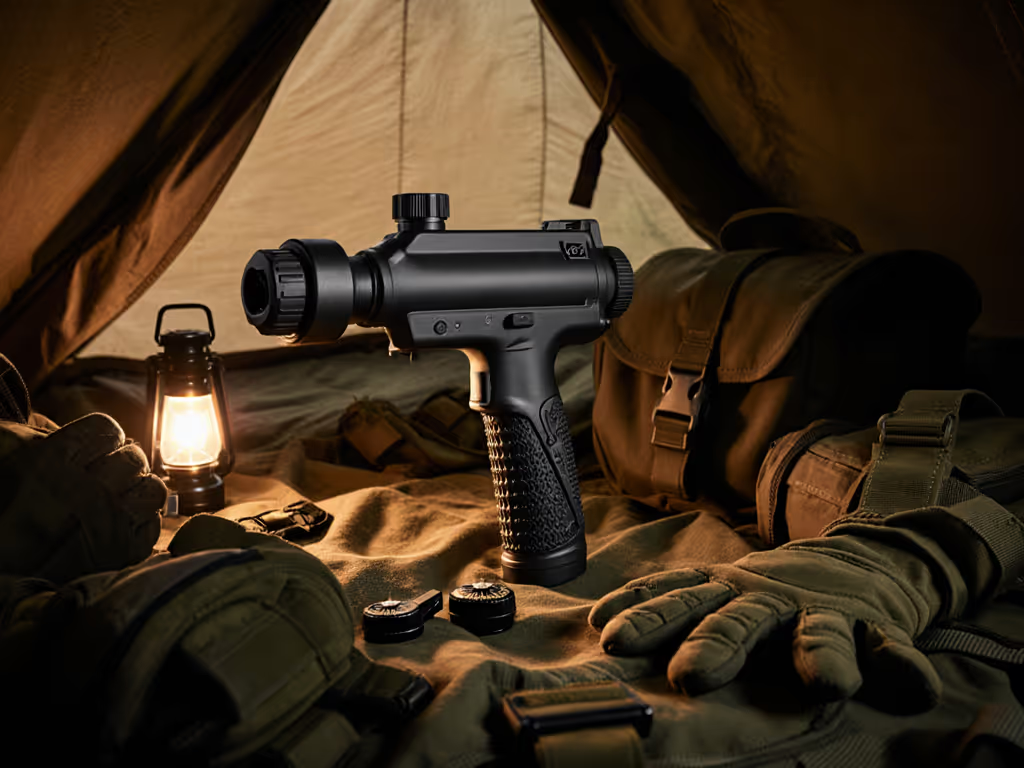
A tactical massage gun comparison for combat athletes and field operatives demands more than raw power. It demands discipline in the specs that actually matter in shared quarters, pre-deployment holds, and after-action wind-downs. When your military recovery tools live in a footlocker or rucksack, every decibel and pound counts. This guide cuts through the noise (literally) to isolate five models that prioritize stealth, durability, and the charging ecosystem real soldiers need.
Why Quiet and Compact Matter in Tactical Contexts
A massage gun that rattles your bunk at 0300 or announces itself in a field hospital isn't a recovery tool (it is a liability). Standard civilian models often ship with decibel levels north of 55 dB, the kind of percussion that pulls eyes in a gym and wakes teammates in shared billets. For decibel-tested picks that stay discreet in shared spaces, see our quietest massage guns tested. Paired with proprietary chargers, bulky cases, and handles engineered for spa comfort rather than fieldwork, most off-the-shelf options become drawer clutter faster than they deliver relief.
Soldier-specific recovery demands combat athlete recovery protocols that compress into a rucksack, charge via standard ecosystem cables, and operate quietly enough for pre-mission activation or post-patrol decompression. Durability isn't nice-to-have (it is non-negotiable when gear lives in dust, salt water, and the occasional drop).
The Five Picks
1. Toloco EM26 - The Quiet Operator's Choice
If you're prioritizing decibel discipline, the Toloco EM26 delivers at 47.1 dBA, quieter than most competitors and well below the threshold that triggers shared-space friction. At 1.95 pounds, it's light enough for extended hand-fatigue-free sessions. The amplitude measures 0.47 inches with a stall force of 17.2 pounds, enough to reach deep muscle without requiring a power outlet intervention mid-deployment.
The real tactical win: 10 interchangeable heads mean you're not forced into a one-size-fits-all percussion. Not sure which tip to deploy? Use our best attachment by muscle group guide to match heads to quads, shoulders, and smaller stabilizers. Field-deployable recovery often means working sore quads after a ruck march, then switching to gentler rotator-cuff attention. This unit lets you dial that precision without carrying five devices.
Constraint checklist:
- Sound signature: Sub-50 dB (quiet-first)
- Stall force: Adequate for deep tissue without stalling mid-stroke
- Attachment variety: Ten heads for variable tissue targets
- Weight: Under 2 lbs (rucksack-friendly)
- Charging: Verify USB-C vs. proprietary before purchase (critical for deployed settings)
2. Theragun Prime - The Standard-Issue Performer
The Theragun Prime represents the Goldilocks zone for tactical use: sufficient amplitude (16 millimeters, equivalent to 0.63 inches), five speed levels spanning 1,750 to 2,400 percussions per minute, and stall force rated at 30 pounds. It's been vetted across years of continuous testing and remains a baseline for professionals balancing power with portability.
The Bluetooth-enabled app integration matters more than marketing suggests. See which app features are worth buying for real-world recovery in the field. Guided recovery routines eliminate decision fatigue during high-stress downtime. For soldiers rotating through standard bunking, the four included attachments cover 80% of typical soldier-specific recovery protocols. The device integrates FSA/HSA eligibility, a practical detail if recovery budgets flow through administrative channels.
Tactical specifications:
- Amplitude: 16 mm (deep-tissue capable)
- Force: 30 lbs stall (handles resistance without stalling)
- Speed range: 1,750 to 2,400 PPM (customizable via app)
- App-guided routines: Pre-loaded protocols reduce cognitive load
- Weight: Moderate (not specified in testing, but within carry-on limits)
3. Theragun Mini (3rd Gen) - Compact Deployment Asset
For field-deployable scenarios where space borders on precious, the Mini collapses the footprint without surrendering efficacy. Its 0.47-inch amplitude and compact grip solve the mid-back solo-massage problem that plagues taller users in confined spaces. The third-generation refresh strengthens durability. Impact-resistant design matters when your gear lives in transit.
This is the device that vanishes into a cargo pocket and earns zero attention at the gate. No bulk, no rattle, no questions, just effective percussion that supports the gate-to-seat routine, then lights protocol for long-haul operational readiness. Travel-heavy soldiers and athletes rotating between duty stations will find its weight-to-capability ratio unmatched.
Compact-specific advantages:
- Profile: Pocketable design (disappears when stowed)
- Durability: Impact-resistant casing for field durability
- Motor: Powerful enough for quads and glutes despite small form
- Grip: Ergonomic angle for solo mid-back access
- Battery life: Sufficient for multi-day field ops without daily recharging
4. Bob and Brad D6 Pro - High Stall Force, Lower Price
For teams purchasing in bulk or soldiers managing recovery on a standard allowance, the Bob and Brad D6 Pro delivers 85 pounds of stall force, exceeding even premium Theragun models. The seven included heads and five speed tiers provide attachment variety without requiring separate purchases. At approximately $250, it's priced below the Pro-tier alternatives, a meaningful constraint when budgets are finite.
Trade-off: This model carries more weight and bulk than the Toloco or Mini, making it better suited to stationary forward operating bases than rucksack rotation. Durability testing by non-manufacturer sources remains limited, so if this lands in your recovery arsenal, verify warranty coverage and battery-cell longevity before committing to extended field deployment.
Bulk-purchase considerations:
- Stall force: 85 lbs (industry-leading)
- Attachments: Seven heads (comprehensive coverage)
- Price point: ~$250 (budget-conscious for team procurement)
- Portability: Not ideal for ultra-light scenarios
- Power: Handles deep-tissue without compromise
5. Hyperice Hypervolt 2 Pro - Cross-Functional Athlete Edge
When your unit includes both sedentary-office personnel recovering from sitting and high-output combat athletes managing explosive-movement soreness, the Hyperice Hypervolt 2 Pro bridges both needs. Its 0.50-inch amplitude and 2,700 PPM top speed support serious deep-tissue work, while the quieter motor relative to some peers keeps shared-space friction minimal.
The Hypervolt line has earned credibility in multi-sport professional settings, including military sports performance programs. If your unit's recovery culture emphasizes evidence-based protocols and cross-training, this model integrates well into standardized deployment plans. The lighter weight relative to Theragun Pro-tier options reduces hand fatigue during team-wide massage rotations. That is critical when one device cycles through 10+ soldiers in a communal setting.
Cross-functional specs:
- Amplitude: 0.50 in (balanced depth)
- Speed: Up to 2,700 PPM (high cadence for varied tissue response)
- Stall force: 17 lbs (adequate for athletes, less jarring for desk workers)
- Motor noise: Quieter profile relative to power output
- Durability: Established track record across military athletic programs
Constraint-Led Selection Framework
Choosing the right field-deployable massage guns isn't about stacking the highest numbers, it is about eliminating friction. Ask yourself:
- Noise limit: Will this device operate during sleep hours in shared spaces? Sub-50 dB models (Toloco) offer genuine advantage; 58+ dB units risk becoming resented tools.
- Charging reality: Does your deployment have reliable USB-C access, or are you dependent on proprietary chargers that break and become impossible to replace downrange? Verify before purchase.
- Weight budget: Will this live in your rucksack weekly, or stay in a fixed recovery station? Every pound compounds over time.
- Solo ergonomics: Can you reach your own mid-back and glutes comfortably, or will you depend on a teammate to finish the job? Handle length and grip angle matter.
- Attachment softness: Will the included heads feel therapeutic on sensitive areas (shins, IT band, feet), or will you need aftermarket soft-tissue attachments?
- Battery endurance: How many soldiers will share this device in a single session before recharging becomes necessary? For real runtime data across popular models, check our longest battery massage guns testing.
The Gate-to-Seat Protocol: Real-World Integration
Tactical massage gun utility lives or dies in actual habit formation. A device selected with all the right specs but never used is worse than no device at all. The winning models here integrate into micro-protocols:
- Pre-deployment activation: 3 to 5 minutes on calves, quads, and glutes to prime movement quality before high-output training or mission rehearsal.
- Post-patrol flush: 5 to 7 minutes on primary load-bearing areas (glutes, quads, shoulders) to reduce DOMS onset and speed recovery between rotations.
- Bunk-down wind-down: 3 to 4 minutes on neck, shoulders, and back before lights-out, using the quietest model available to avoid teammate disruption.
Despite manufacturer claims of "recovery acceleration," the real benefit is psychological permission, a tangible ritual that signals your body to downshift from sympathetic dominance. The device that integrates into this routine without friction will earn adherence; the one that requires a charging hunt or produces guilt-inducing noise will not.
What Tactical Durability Actually Means
Military-grade doesn't require five-star ruggedization ratings. It requires predictable failure patterns. A grip that loosens after 200 hours of use is unacceptable. A motor that loses power after 18 months is unacceptable. A proprietary charger that snaps and becomes unreplaceable is unacceptable.
The models listed here have demonstrated durability across independent testing in high-output environments. Before purchase, verify:
- Warranty coverage: Does the manufacturer back the unit for 2+ years? Compare brand policies in our massage gun warranty comparison.
- Motor longevity: Are there documented reports of motor burnout after 12 to 18 months of daily use?
- Attachment durability: Do heads crack, strip, or become loose after repeated insertion and removal?
- Battery degradation: Does capacity hold at 80%+ after 200+ charge cycles?
Further Exploration: Building Your Unit Recovery Program
A single massage gun is one tool in a larger recovery architecture. Combat athlete recovery protocols integrate percussion therapy with sleep prioritization, hydration discipline, and movement quality. Not as trophies, but as systems that enable performance.
If this comparison resonates, consider:
- Testing locally first: Rent or borrow a unit from your unit's athletic trainer before committing to a purchase. Hand feel and noise perception vary by individual.
- Pairing with guidance: Download the companion app (if available) and run through one guided routine before field deployment to validate the device's fit with your body size and joint range.
- Building a team protocol: If you're selecting for a unit, establish a shared checklist (noise limit, charging method, attachment softness) and test 2 to 3 models simultaneously with representative soldiers across body types and strength levels.
- Monitoring adherence: Set a 30-day usage target and track which soldiers actually integrate the device into their routine. The model that wins isn't always the most powerful, it is the one that disappears into habit.
The best tactical gear durability comes not from marketing language but from quiet, reliable performance that soldiers reach for without thinking. Start there, and let the numbers confirm what your hand already knows.
Related Articles